

- About
- Programs
- View all programs
- Professional Bachelor in Hospitality Management


- Bachelor of Arts in International Hospitality Management

- Master of Arts in International Hospitality Business Management
- Master of Arts in International Hospitality Business Management: Luxury Brand Management

- Master of Science in International Hospitality Management

- Master of Arts in Executive Hospitality Management (online)

- Master of Business Administration - MBA Global

- Postgraduate Diploma to Master of Advanced Studies in Business

- Postgraduate Diploma in International Hotel, Resort, and Spa Management

- Campus life
- Career Services
- Admissions
- News & Events
- Alumni










What Is Hospitality Management? Careers, Skills & Degrees
Discover what hospitality management involves, its core areas, typical salaries, and how a Swiss degree with paid internships starts your career.


Key Takeaways
- Hospitality management involves running guest-focused businesses, including hotels, restaurants, event venues, cruise lines, and wellness facilities.
- Managers coordinate daily service operations with business functions such as budgeting, revenue management, and staffing.
- Career options include hotel management, food and beverage, and events, along with roles in luxury retail and other service-focused industries.
- Practical experience helps graduates prepare for management roles. SHMS bachelor's students complete two paid six-month internships as part of their studies.
Hospitality management plays an important role in how hotels, restaurants, resorts, and other guest-focused businesses operate. Behind every successful guest experience are managers responsible for the people delivering the service, the decisions that affect its quality, and the financial performance of the business.
It is also a field with opportunities well beyond hotel operations. The World Travel & Tourism Council (WTTC) expects travel and tourism to support 376 million jobs worldwide in 2026, equivalent to roughly one in nine jobs. For those considering a career in the industry, understanding hospitality management means understanding both how these businesses operate and the skills needed to lead them.
At Swiss Hotel Management School (SHMS), students study these principles while gaining practical experience in former Swiss palace hotels at Caux and Leysin.
What Is Hospitality Management?
Hospitality management involves overseeing the operations and business performance of organizations that serve guests. While hospitality refers to the welcome and care people receive, managing a hospitality business means organizing the work behind that experience. This includes maintaining service standards, leading employees, and making decisions that support the business financially.


Start Your Journey in the World of Hospitality
Turn your passion into a rewarding international career
The responsibilities generally fall into four areas:
- Operations: keeping rooms, restaurants, events and facilities running to standard every day
- People: hiring, training, scheduling and leading teams that often span many nationalities
- Commercial performance: pricing, sales, budgeting and cost control
- Guest experience: setting service standards and resolving problems before they reach a review site
A hotel general manager may oversee all four areas, while department managers focus on particular functions. Similar responsibilities apply to a cruise line's hotel director or a restaurant group's operations director, even though the working environment is different.
Hospitality management vs hotel management
Hotel management focuses on running hotels and other accommodation properties. Hospitality management covers a broader range of businesses, including restaurants, event venues, cruise lines, and wellness facilities. This difference is reflected in the subjects students study and the careers they can pursue.
Hotel management | Hospitality management | |
Scope | Hotels, resorts, serviced apartments and hotel management companies | All guest-facing businesses, including hotels, restaurants, events, travel, wellness and attractions |
Typical employers | International hotel groups and independent properties | Hotel groups, restaurant groups, event agencies, cruise lines, luxury brands and clinics |
Typical first roles | Front office supervisor, assistant housekeeping manager, food and beverage supervisor, management trainee | Event coordinator, restaurant supervisor, guest relations executive, sales coordinator |
Sectors hospitality management covers
Hospitality management graduates work across a range of industries, including sectors where customer experience is closely linked to commercial performance such as:
- Hotel chains and resorts
- Restaurants, bars and food service chains
- Conference, exhibition and event venues
- Airlines, cruise and travel
- Luxury brands and retail
- Wellness, spas and medical clinics
- Entertainment and attractions
- Public sector and institutions (hospitals, universities)
- Serviced residences and real estate
- Hospitality technology and services
Core Areas of Hospitality Management
A hospitality business depends on departments that have different responsibilities but contribute to the same operating results. Managing these functions involves understanding how decisions about staffing, pricing, and service affect one another.
The functional areas of hospitality management
In hotels, staff positions are usually organized into departments according to their responsibilities. Many of these functions are also found in other hospitality businesses, although the structure varies by organization:

- Rooms division covers front office, concierge, reservations and housekeeping. It sells rooms and prepares them. A typical decision is how many rooms housekeeping can turn before a 60-person group arrives at 2 p.m.
- Food and beverage runs restaurants, bars, room service and banqueting. A typical decision is setting a banquet price per head that covers food cost and labor.
- Finance and revenue handles accounting, budgeting, purchasing and pricing. For example, revenue management raises room rates when a trade fair fills the city.
- Sales and marketing looks after brand, distribution, group sales and public relations. A typical decision is how many rooms to release to online travel agencies and how many to keep for direct bookings.
- People covers interviewing, hiring, training and managing staff. At a ski resort, this team builds the seasonal hiring plan.
- Guest experience sets service standards and handles complaints and inquiries. A typical decision is authorizing an upgrade after a guest's arrival goes wrong.
- Facilities manages maintenance, spa and leisure areas, energy use and health and safety compliance. One example is scheduling pool repairs for the quietest week of the year.
Managers track performance with a shared set of numbers:
- Occupancy: the share of available rooms sold
- Average daily rate (ADR): average revenue per occupied room
- Revenue per available room (RevPAR): occupancy multiplied by ADR, the figure most hotel owners watch
- Guest satisfaction scores: results from post-stay surveys and online reviews
- Labor cost: staff costs as a share of revenue
Sustainability cuts across every area. A hotel that sets out to reduce food waste needs the kitchen to plan menus around shared ingredients and the purchasing team to order smaller, more frequent deliveries. Finance then reports the savings against the food cost target.
How the areas work together
The connection between departments becomes clearer when looking at a guest's stay. For example, a three-night anniversary booking at a mountain resort may involve several teams:
- Sales and revenue: the couple books a midweek package that the revenue team priced to fill quieter nights.
- Rooms division: reservations records the anniversary. Housekeeping prepares the room, and the front office times the welcome.
- Food and beverage: the restaurant holds a window table, and the sommelier plans a wine pairing for the second evening.
- Facilities: the spa books a couples treatment, and maintenance confirms the outdoor pool is heated.
- Guest experience and finance: after checkout, a satisfaction survey goes out. The stay's revenue and costs then feed into the monthly report.
SHMS students practice this coordination from their first semester at Caux. There, the Service and Kitchen Practice module runs alongside Food and Beverage Cost Control, so students learn service and its costs in the same term.
How hospitality management is changing

The responsibilities of hospitality managers continue to change as businesses introduce new technology and respond to changing guest expectations. Several developments are influencing daily operations:
- Data in pricing and service: Revenue systems update rates as demand moves, and AI tools now forecast staffing and draft replies to guests. Managers need to read that data and challenge it when it looks wrong.
- Personalization: Guest profiles let hotels remember preferences across stays and properties. The management skill lies in using that information in ways guests welcome.
- Sustainability targets: Many hotel groups now report emissions and waste publicly, which turns energy use and purchasing into performance measures.
- Workforce skills: WTTC lists workforce skills alongside digital innovation and sustainable destination management as investments the sector needs to keep growing.
The SHMS curriculum reflects these changes. Bachelor students take Data-Driven Decision-Making in their third semester, and the Hospitality Management specialization includes AI and Digital Innovation along with Ethics, Sustainability and Business Culture. Every student receives an iPad at the start of their studies, part of the approach that has earned SHMS recognition as an Apple Distinguished School.
Key Skills in Hospitality Management
Hospitality managers need a combination of business knowledge and people skills to keep operations running smoothly and maintain high service standards. They must understand how their decisions affect a company's financial performance while managing the teams responsible for delivering the guest experience.
Business and operational skills
Managing a hospitality business involves making decisions about budgets, staffing, pricing, and daily operations. Managers need to understand the financial side of the business and use performance data to identify problems and make improvements.
At Swiss Hotel Management School (SHMS), students develop these skills through courses that connect business principles with hospitality operations.
Skill | What it involves |
Finance and budgeting | Managing department budgets and understanding financial performance |
Revenue management | Adjusting room rates and other prices based on demand |
Analysis and critical thinking | Using operating data to assess performance and make decisions |
Operations planning | Coordinating staffing, supplies, and daily activities |
Hospitality technology | Using software to manage operations and support business decisions |
People and service skills
Much of hospitality management involves working with people, often in busy environments where managers need to make decisions quickly. Alongside their technical knowledge, managers need the communication and leadership skills to support employees and respond to guests' needs.
Important skills include:
- Leadership and delegation: Assigning responsibilities and helping employees perform effectively.
- Teamwork: Coordinating with colleagues across different departments.
- Communication: Giving clear instructions and interacting professionally with guests and employees.
- Problem-solving: Responding to complaints and unexpected operational problems.
- Cross-cultural awareness: Working effectively with people from different backgrounds.
- Language skills: Communicating with international guests and colleagues.
- Networking: Building professional relationships with colleagues and industry contacts.
SHMS students develop these skills through practical training and paid internships. They also study alongside classmates from more than 60 nationalities in an English-speaking environment, with French or German language courses in their first year.
Why these skills transfer beyond hospitality
The combination of business knowledge and service experience is useful in industries where customer relationships contribute directly to business performance.
In luxury retail, for example, managers need to understand sales targets while providing personalized customer service. Real estate professionals rely on similar skills when managing properties and working with clients. Banking client service, aviation, and healthcare also require employees who can coordinate services and maintain professional standards when working directly with customers or patients.
SHMS graduates have applied their hospitality education in several of these industries. Alumnus Malvin Hartwell joined Louis Vuitton in Jakarta after graduation, starting as a salesperson before progressing to senior salesperson and then team manager within six months.
Reflecting on his experience in luxury retail, Hartwell explained:
"I realised the essence of being a good salesperson is people service."
His experience illustrates how the service skills developed through hospitality education can remain relevant when graduates pursue careers outside hotels.
Hospitality Management Careers and Salaries
Hospitality management graduates can pursue operations, commercial, and leadership roles across hotels and other service-focused industries, with salaries generally increasing as they progress from supervisory positions to general management.
Common roles and what they pay
Career opportunities vary depending on the industry and the area of business you choose to specialize in. Some roles focus on managing daily operations, while others involve overseeing revenue, employees, or customer relationships.
The table below shows average U.S. base salaries reported by Indeed in 2026.
Role | What the role does | Average annual salary (U.S.) |
Oversees hotel operations and guest services | $65,784 | |
Manages food service operations and staff | $57,602 | |
Organizes conferences, weddings, and other events | $51,251* | |
Oversees residential or commercial properties | $66,846 | |
Manages recruitment and employee relations | $88,322 | |
Leads sales teams and manages revenue targets | $96,566 | |
Oversees guest satisfaction and service quality | $65,589 | |
Manages spa operations and services | $60,237 | |
Oversees brand positioning and marketing | $92,833 |
Actual earnings depend on experience, location, employer, and level of responsibility.
A typical career path from intern to general manager
Hospitality careers often begin with practical experience in guest-facing or operational roles. As employees gain experience, they may move into positions with responsibility for larger teams and eventually the performance of an entire property.

A common progression looks like this:
Career stage | Illustrative career timing | Typical responsibilities |
1. Internship | During studies | Learning daily operations and gaining experience across departments |
2. Supervisor | Years 0–3 after graduation | Managing shifts, supporting employees, and maintaining service standards |
3. Assistant department manager | Years 2–5 | Helping manage departmental budgets, staffing, and performance |
4. Department head | Years 5–10 | Taking responsibility for an entire department and its results |
5. General manager or director | Often 10+ years | Overseeing property operations, financial performance, and department leaders |
These timeframes are illustrative, not published industry averages. Career progression varies considerably by employer, property size, and individual experience.
Job outlook for the hospitality management field
Employment opportunities in hospitality are closely connected to demand for accommodation, travel, and guest services.
The U.S. Bureau of Labor Statistics (BLS) projects employment of lodging managers to grow by 4% between 2025 and 2035, about as fast as the average for all occupations. It also projects approximately 5,500 job openings annually over that period, including positions created when existing workers leave the occupation.
Globally, the World Travel & Tourism Council's Economic Impact Research reports that travel and tourism supported 366 million jobs in 2025, approximately one in nine jobs worldwide. Its May 2026 forecast expects that number to reach 376 million in 2026, reflecting the sector's continued contribution to global employment.
SHMS graduates also benefit from access to employers through the school's International Recruitment Forum, held twice a year. The school's recruitment information reports participation by more than 100 recruiters from over 30 countries. SHMS also reports that 90% of graduates receive more than one job offer before graduation.
Starting your own hospitality business
Hospitality management skills are also valuable for graduates interested in starting their own businesses. Running a restaurant, boutique hotel, event agency, or wellness business requires an understanding of operating costs and how to deliver a service that encourages customers to return.
For entrepreneurs, these responsibilities are closely connected. A restaurant owner, for example, needs to set prices that cover expenses while maintaining the quality customers expect. Similar considerations apply when managing a boutique hotel or developing a new wellness concept. Decisions about staffing and service standards all affect the business's financial performance.
At SHMS, students prepare for these responsibilities through a combination of business courses and practical experience. Subjects such as accounting and project management develop their commercial knowledge, while practical training and two paid internships give them experience working with guests and supporting daily operations. Students specializing in Event Management also study Entrepreneurship in Hospitality and Events.
SHMS alumna Ekaterina Tushishvili provides an example of how this education can support entrepreneurship. After graduating with bachelor's and master's degrees in Hotel Management in 2006, she went on to establish a four-star boutique hotel in Tbilisi, Georgia. Together with her brother, she also launched Terminal, a coworking business that expanded to five locations and more than 100 employees.
Tushishvili credits her Event Management studies with teaching her the importance of having a clear business concept before pursuing it. She also draws on lessons from her coursework and internship when managing employees, particularly the importance of maintaining service standards and leading by example.
How to Study Hospitality Management
You don't necessarily need a degree to begin a hospitality career. The U.S. Bureau of Labor Statistics notes that some lodging managers enter the field with a high school diploma and years of relevant experience. Larger hotels may prefer candidates with a bachelor's degree for management roles.
SHMS offers qualifications for students entering hospitality for the first time and for professionals looking to develop their careers.
Students starting their careers can choose the Swiss Professional Degree in Hospitality Management or a bachelor's degree in International Hospitality Management. Both combine classroom learning with paid internships.
For university graduates and professionals looking to advance or change careers, SHMS offers master's degrees in hospitality management, along with postgraduate and online study options.
Students can also build on their qualifications. For example, Swiss Professional Degree graduates can continue toward a bachelor's degree, while bachelor's graduates can pursue master's-level studies.
To learn more about the subjects covered and the qualifications available, read our guide to hospitality degrees.
Hospitality management vs business management degrees
Both hospitality management and general business degrees cover subjects such as finance, marketing, and management. Hospitality management degrees focus more closely on applying this knowledge in service-based businesses. Depending on the program, students may also gain experience through supervised placements or practical work in hotel and event operations.
Hospitality management degree | Business management degree | |
Core subjects | Accounting, marketing and leadership, plus rooms division, food and beverage and revenue management | Accounting, marketing, economics, leadership and strategy |
Practical training | Live service, kitchen and event work on campus | Case studies and group projects |
Internships | Built into the program and supervised | Optional or self-arranged at many universities |
Typical first roles | Department supervisor, management trainee, event coordinator | Analyst, sales or marketing associate, graduate trainee |
Industries reached | Hospitality, travel, events, luxury, real estate and finance | Most sectors, with less direct access to hospitality and luxury employers |
What learning looks like at SHMS


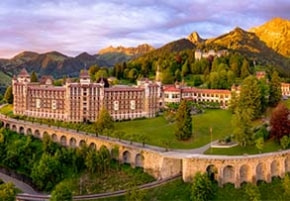
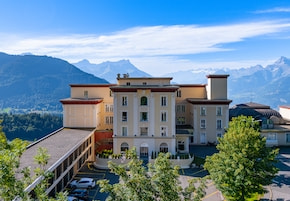
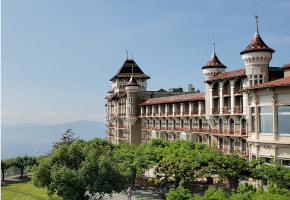
Both SHMS campuses are former palace hotels. Caux Palace overlooks Lake Geneva above Montreux. In Leysin, students live and study in the Mont-Blanc Palace and the Belvédère, two former palace hotels joined by a private Skytrain; the Mont-Blanc Palace was once the world's first winter Club Med.
Bachelor students spend their first year at Caux on food and beverage and rooms division, then move to Leysin for their specialization. They choose Hospitality Management, Event Management or Design Management, and in the final semester each student completes a digital portfolio project, such as a hotel business plan or a company event.
Why study hospitality management in Switzerland
Switzerland has a long history of hotel education dating to the 19th century. For students interested in international hospitality careers, studying there offers exposure to the country's approach to service and, at SHMS, practical training in former palace hotels.
In the 2026 QS World University Rankings, SHMS placed in the top 4 worldwide for Hospitality and Leisure Management. The Swiss Professional Degree is recognized by the Swiss State Secretariat for Education, Research and Innovation (SERI) and is equivalent to European Qualifications Framework (EQF) Level 6. At Caux and Leysin, Swiss service standards are part of daily campus life.
Internships and industry connections
Bachelor and Swiss Professional Degree students complete two paid six-month internships at properties around the world. Students choose between two pathways. They can complete a full academic year before the first internship, or alternate six months of study with six months of work from the first year. Internship and career coaches help students research employers, prepare CVs and practice interviews.
The International Recruitment Forum runs twice a year and brings in more than 100 recruiters from hotel groups, independent properties, events companies, retail, banking, airlines and cruise lines. Recruitment partners include Four Seasons, Mandarin Oriental, Marriott International, Rosewood, Royal Caribbean and UBS.
BA student Amanda completed her internship at Rosewood Hotels and Resorts in Hong Kong, dividing her time in the VIP lounge between food and beverage and reception. Recruiters value that kind of experience. Julian Ryan, a corporate human resources manager at Kempinski Hotels, says SHMS students "can live up to our product and promise."
Is a Hospitality Management Career a Good Fit for You?
A hospitality management career may suit you if you enjoy working with people and are interested in how businesses operate. Roles in hotels and events often involve changing priorities throughout the day, and international employers may offer opportunities to work in different countries. SHMS graduates also become part of an alumni network of more than 17,500 members.
Working conditions are an important part of the decision. Hotels operate during evenings, weekends, and holidays, and some managers remain on call outside their normal shifts. Early-career employees may also work irregular hours, particularly in guest-facing departments.
Hospitality management may be a good fit if you:
- Enjoy working with people
- Stay calm under pressure
- Like variety in your day
- Feel comfortable with numbers
- Are open to relocating
- Are interested in leadership
These interests can also lead to opportunities beyond hotels. Businesses in luxury retail and real estate, for example, value professionals who understand customer relationships and can manage service operations effectively.
For SHMS graduate Eric Masalwala, hospitality education provided the foundation for a career in international hotel management. After graduating in 2007, he went on to hold senior management positions, including General Manager at Premier Inn Hotels. Reflecting on the value of his education, he shared:
"My degree turned me into a true hospitality professional and prepared me for what has been a thrilling journey with one of the leading hospitality brands in the world."
His experience reflects the opportunities available to graduates who combine business knowledge with practical hospitality training. At SHMS, students begin developing that experience during their studies through hands-on learning and paid internships, preparing them to pursue careers in hospitality management and related industries.
Explore the BA in International Hospitality Management to learn more about the curriculum, practical training, and career opportunities available to SHMS graduates.
Frequently Asked Questions
Is a hospitality management degree worth it?
For most people targeting management, yes. A degree shortens the route to department head and general manager roles, particularly at full-service and luxury properties. 90% of SHMS graduates receive more than one job offer before graduation. Cost, career goals and the employers you want to work for all affect the answer, which is weighed in more detail in our analysis of whether a hospitality degree is still worth it.
Why is hospitality management important?
Travel and tourism support one in nine jobs worldwide, and every hotel, restaurant and event depends on managers to keep service consistent and costs under control. Good management decides whether guests return and whether owners see a return on their investment.
Can you study hospitality management with no industry experience?
Yes. The SHMS bachelor program requires completed secondary school, a minimum age of 17 and English at IELTS 5.5 or equivalent. The MA in International Hospitality Business Management accepts holders of a recognized bachelor's degree in any discipline without prior hospitality experience.
Is a Swiss hospitality degree recognised internationally?
Yes. The SHMS Swiss Professional Degree is recognized by SERI and is equivalent to EQF Level 6, which supports recognition across most of Europe. SHMS bachelor and master's degrees are awarded or accredited with the University of Derby in the UK.
What is the difference between hospitality and tourism management?
Hospitality management focuses on running the businesses that host guests, such as hotels, restaurants and venues. Tourism management looks at destinations and travel flows, including tour operations and destination marketing. The two overlap heavily, and many graduates move between them.
Which languages help most in hospitality management?
English is the working language of international hospitality. A second language should match the market where you plan to work, such as French or German in Switzerland, Arabic in the Gulf or Mandarin in China. SHMS students study French or German during their first year.
Are you wondering where to start your dream hospitality career? Look no further than a bachelor’s degree at Swiss Hotel Management School.