- About
- Programs
- View all programs
- Professional Bachelor in Hospitality Management

- Bachelor of Arts in International Hospitality Management

- Master of Arts in International Hospitality Business Management

- Master of Arts in International Hospitality Business Management: Luxury Brand Management

- Master of Science in International Hospitality Management

- Master of Arts in Executive Hospitality Management (online)

- Master of Business Administration - MBA Global

- Postgraduate Diploma to Master of Advanced Studies in Business

- Postgraduate Diploma in International Hotel, Resort, and Spa Management

- Campus life
- Career Services
- Admissions
- News & Events
- Alumni










What Is Hospitality and Tourism? Differences & Careers
Learn what hospitality and tourism mean, how the two industries differ and connect, the careers they offer, and how to start with a Swiss degree.

Key Takeaways
- Tourism is the movement of people to places outside their usual environment, for leisure, business or other purposes.
- Hospitality is the group of businesses that host, feed and look after those travelers, as well as local guests.
- Tourism explains why and where people travel. Hospitality covers how they are hosted once they arrive, and the two overlap in airlines, cruise ships, resorts and events.
- Roles range widely, from hotel, resort and restaurant management to event planning, tour management and travel consulting.
- For people who enjoy service and working across cultures, it is a strong career choice. Travel and tourism are expected to support 376 million jobs worldwide in 2026.
- Many entry roles need no degree. A hospitality degree with built-in internships speeds progression into management and opens doors with international employers.
UN Tourism counted an estimated 1.52 billion international tourist arrivals in 2025, a 4% rise on 2024 and almost 60 million more travelers. Each of those trips relied on businesses across both sides of the industry, and each of those businesses needs trained people to run it.
Hospitality and tourism is one large, connected industry: lodging, food, transport, events and recreation, which together bring income and employment to destinations around the world.
What Is Tourism?

Tourism covers travel to places outside a person's usual environment. People travel for leisure, business, culture, education or health, or to visit friends and family.
Tourism is usually described by the direction of travel:
- Domestic tourism: residents traveling within their own country, such as a Zurich family spending a week in Ticino
- Inbound tourism: visitors arriving from abroad, such as American travelers on a tour of Swiss cities
- Outbound tourism: residents traveling to another country
- International tourism: inbound and outbound travel combined, the figure UN Tourism tracks in its global arrivals data
A single trip draws on many businesses. These include airlines and rail operators, hotels and restaurants, travel agencies and tour operators, destination marketing organizations and attractions. Spending by visitors gives destinations income, supports local employment and keeps small businesses open in places that might otherwise struggle to sustain them.
Types of tourism
Travelers' motives shape the market, and each type of tourism has its own businesses and career specialties:
- Leisure and sightseeing: holidays built around rest and landmarks, such as a week in Paris visiting museums and monuments.
- Adventure tourism: physically active trips, such as glacier hiking in the Bernese Oberland.
- Eco and sustainable tourism: travel designed to limit environmental impact and support local communities, such as staying in a certified eco-lodge in Costa Rica.
- Cultural tourism: travel to experience heritage, food, festivals and art. A visitor attending the Montreux Jazz Festival is a cultural tourist, and the wider field of cultural tourism includes everything from museum trips to culinary tours.
- Business and MICE tourism: travel for meetings, incentives, conferences and exhibitions, such as a pharmaceutical congress in Geneva.
- Wellness tourism: trips focused on physical and mental well-being. Wellness tourism covers thermal spas, medical clinics and retreat programs.
- Experiential travel: trips built around taking part, such as a cheese-making workshop with an Alpine farmer. Experiential travel gives travelers a role in the trip.
What Is Hospitality?
Hospitality encompasses the businesses and services that make guests feel welcome and cared for. It includes hotels and resorts, restaurants and bars, cruise ships, theme parks, events and leisure venues. The broader idea of what hospitality is goes back to the welcome a host offers a stranger. As an industry, it turns that welcome into a business that runs every day to a set standard.
Quality hospitality shows in the details. Staff anticipate what a guest needs before they ask, standards hold whether the hotel is full or quiet, and the stay leaves something guests remember and mention to others.
Tourism depends on hospitality, because travelers need somewhere to sleep and eat wherever they go. Hospitality also serves people who never leave home: the neighborhood restaurant, the wedding venue and the corporate canteen all count as hospitality businesses with mostly local customers.
The five sectors of the hospitality and tourism industry
The industry is commonly grouped into five sectors:
Sector | Example businesses | Example roles |
Accommodation | Hotels, resorts, serviced apartments, hostels | Front office manager, revenue manager, general manager |
Food and beverage | Restaurants, bars, catering companies, hotel banqueting | Restaurant manager, sommelier, executive chef |
Travel and transport | Airlines, rail operators, cruise lines, tour operators | Cabin crew manager, tour manager, cruise hotel director |
Attractions, entertainment and recreation | Theme parks, museums, ski resorts, golf clubs | Guest experience manager, entertainment manager, activities coordinator |
Events and MICE | Conference centers, event agencies, exhibition organizers | Event planner, conference sales manager, exhibition coordinator |
What Is the Difference Between Tourism and Hospitality?
Tourism is about why and where people travel; hospitality is about how they are hosted once they arrive.
Tourism | Hospitality | |
Main focus | Travel flows, destinations and the trip as a whole | The guest's stay, meals and experiences on site |
Core question | Why do people travel here, and how do they get here? | How do we make each guest feel welcome and want to return? |
Typical businesses | Tour operators, travel agencies, airlines, tourism boards | Hotels, restaurants, bars, event venues |
Typical roles | Tour manager, travel consultant, destination marketer | Hotel manager, restaurant manager, event planner |
Key skills | Itinerary planning, destination knowledge, sales | Service standards, operations, team leadership |
Hospitality forms a large part of the tourism experience. Tourism is the broader field, because it also includes transport, destination management and attractions that may sit outside the hospitality industry.
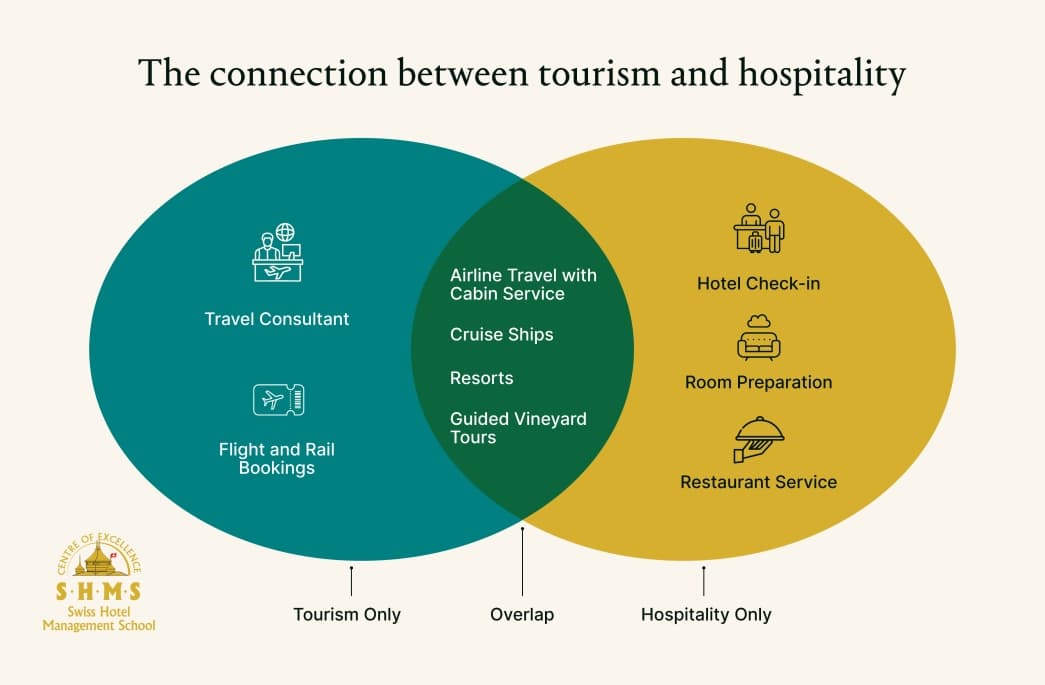
Where tourism and hospitality overlap
An airline shows the overlap clearly. It is a tourism business because it moves travelers, yet the meal service, cabin crew and lounge experience on board are pure hospitality. Resorts, cruise ships and large events work the same way: each sells the reason to travel and then hosts the traveler once they are there.
Start Your Journey in the World of Hospitality
Turn your passion into a rewarding international career
The overlap is easiest to see across a single trip. Take a couple flying to the Swiss Riviera for a long weekend:
- Booking (tourism): a travel consultant builds the itinerary and books flights and rail passes.
- Travel (both): the airline flies them to Geneva, with a cabin crew serving meals on board.
- Stay (hospitality): the hotel checks them in, remembers their anniversary and prepares the room.
- Dining (hospitality): the hotel restaurant and a local wine bar look after their evenings.
- Experiences (both): a guided tour of Lavaux vineyards, sold by a tour operator and hosted by a winemaker.
Every step depends on the one before. That close link between travel and hospitality is why many employers recruit graduates who understand both.
Study both industries at SHMS
The BA in International Hospitality Management at SHMS covers the core of both industries. Students learn food and beverage management and rooms division at Caux, then study MICE and logistics, marketing and hospitality economics at Leysin. Two paid six-month internships take them to hotels, resorts and travel businesses worldwide. Graduates earn bachelor degrees from SHMS and the University of Derby, UK.
Is Tourism and Hospitality a Good Career Choice?
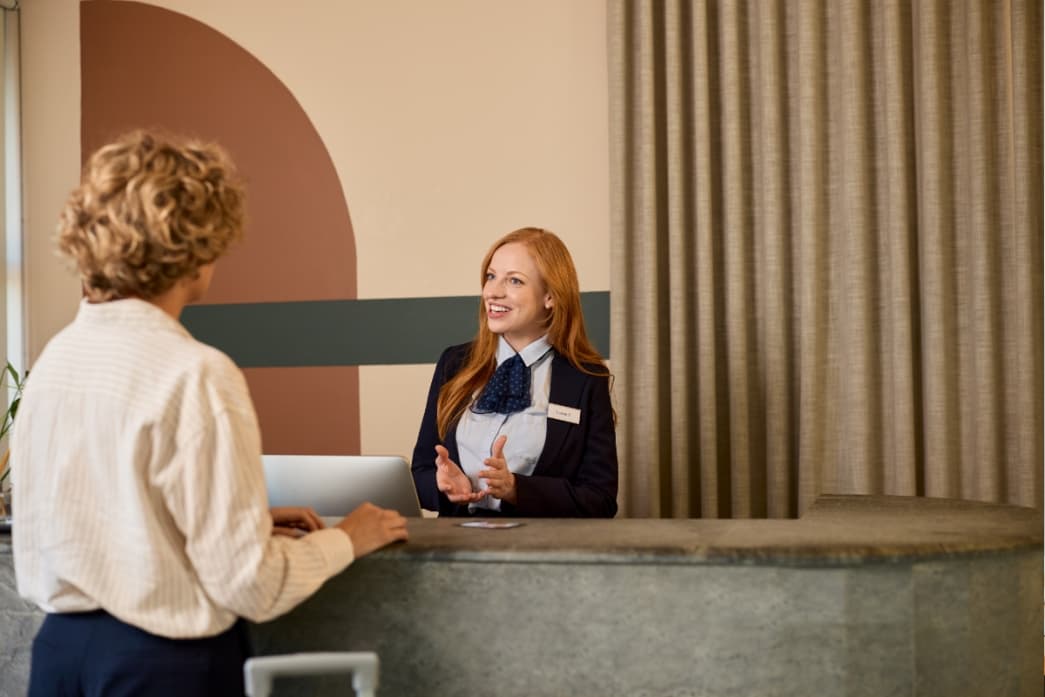
For people who enjoy service, variety and working with people from different cultures, the answer is yes. Global demand is steady, the industry offers many career paths, and the work moves easily across borders, which makes it one of the more natural fields for careers that allow you to travel. The skills involved, such as managing budgets, leading teams and handling demanding clients, also carry into other industries.
The trade-offs are real. Entry-level pay is modest in many roles, and shift work, weekends and holidays are normal, especially early on. Seasonal destinations such as ski resorts can also mean months of intense work followed by quieter periods.
Growth and job opportunities in tourism and hospitality
Demand for travel is still rising. UN Tourism expects international arrivals to grow by 3% to 4% in 2026. Africa led regional growth in 2025, with arrivals up 8% to 81 million, a sign of how tourism creates jobs in emerging destinations as well as established ones.
The employment figures are large. According to WTTC Economic Impact Research, travel and tourism will support 376 million jobs worldwide in 2026, one in every nine jobs, and generate almost 89 million new jobs over the next decade.
In the US, BLS employment projections for 2025 to 2035 vary by role:
- Entertainment and recreation managers: 6% growth, faster than average
- Meeting, convention and event planners: 6% growth
- Lodging managers: 4% growth, about as fast as average
- Travel agents: little or no change, though about 5,900 openings are still expected each year as people leave the role
Switzerland shows how strong demand can be at the destination level. Swiss hotels recorded a record 43.9 million overnight stays in 2025, up 2.6% on 2024, with both foreign and domestic demand reaching new highs. Opportunities span every level, with entry roles at reception or in a kitchen leading to chef, tour operator, travel agent or general manager positions.
Career paths in tourism and hospitality
There are many career path options tied to the tourism and hospitality industry. Among the most common ones are:
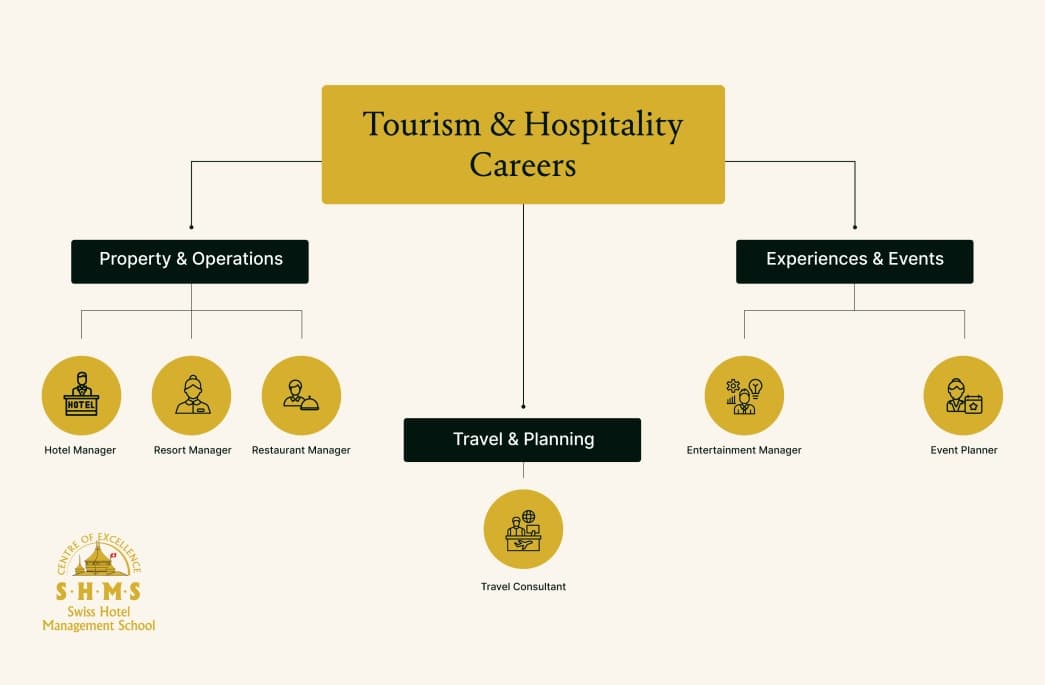
Hotel manager
Hotel managers oversee a property's operations, staff, budgets and guest satisfaction. In a large hotel, they lead department heads in rooms division, food and beverage, sales and finance; in a smaller one, they may handle much of that work themselves. The job calls for commercial judgment as much as service sense, because the manager answers to owners for profit. In the US, lodging managers earned a median of $69,250 in May 2025, and the highest-paid 10% earned more than $128,880. The usual route runs through supervisory and department roles, covered in our guide on how to become a hotel manager.
Restaurant manager
A restaurant manager runs daily operations in a restaurant, bar or hotel outlet. The work includes scheduling and leading the team, controlling food and labor costs, managing suppliers and making sure every table leaves satisfied. Restaurant managers work in independent restaurants, hotel groups, cruise ships and catering companies, and many move on to food and beverage director roles. BLS reports a median of $69,390 for food service managers in May 2025.
Resort manager
A resort manager runs a full-service property where guests often stay for a week or more and rarely leave the grounds. That means overseeing rooms and several restaurants, as well as spa, activities and recreation, with a much wider operation than a city hotel. Seasonal staffing is a large part of the job, especially at ski and beach resorts, where teams are hired and trained in a few weeks before opening. BLS includes resort managers within lodging managers, at a median of $69,250 in May 2025.
Entertainment manager
Entertainment managers plan and run the shows, activities and recreation programs that guests come for. They work in resorts, on cruise ships, at theme parks and in performance venues, and they manage budgets, schedules, safety and staff as well as the program itself. On a cruise ship, the same manager may run a children's club in the morning and a theater show at night. BLS reports a median of $79,520 for entertainment and recreation managers in May 2025.
Event planner

Event planners organize conferences, weddings, corporate gatherings and cultural events. They manage budgets, negotiate with venues and suppliers, and coordinate logistics such as transport, catering and audiovisual equipment, then run the event on the day. The work spans many types of events, and senior planners often move into an event manager role leading a team or agency. BLS reports a median of $61,160 for meeting, convention and event planners in May 2025.
Travel consultant
Travel consultants plan and book trips, advise clients on destinations and build itineraries around their budget and interests. Corporate consultants manage business travel, while leisure consultants often specialize in a region or style of trip. At the top end, a luxury travel advisor designs bespoke trips for high-net-worth clients and relies on close relationships with hotels and suppliers. BLS reports a median of $50,160 for travel agents in May 2025, including commissions.
Newer roles shaped by industry trends
Several roles have grown with changes in how people travel:
- Sustainability manager: sets and tracks energy, waste and sourcing targets as travelers and investors ask for responsible travel.
- Revenue and distribution analyst: uses data and AI-driven pricing tools to set rates and choose sales channels.
- Spa and wellness manager: runs spa and wellness programs as wellness travel grows.
- Luxury guest relations manager: looks after high-value guests in luxury hotels and personalizes each stay.
Where SHMS graduates work
SHMS graduates join an alumni network of more than 17,500 members. Of those graduates, 90% receive more than one job offer before graduation, and 89% hold management positions or have created their own company.
Many work outside hotels. Candace Matson, a 2017 SHMS graduate, became a Guest Experience Manager at The Walt Disney Company, applying hotel-school service training in one of the world's best-known entertainment businesses.
Skills and Qualifications for a Tourism and Hospitality Career
There are certain skills and qualifications one needs to secure positions and succeed in a tourism and hospitality career.
Essential skills for success in tourism and hospitality
Employers in both industries look for a mix of people skills and technical ability:
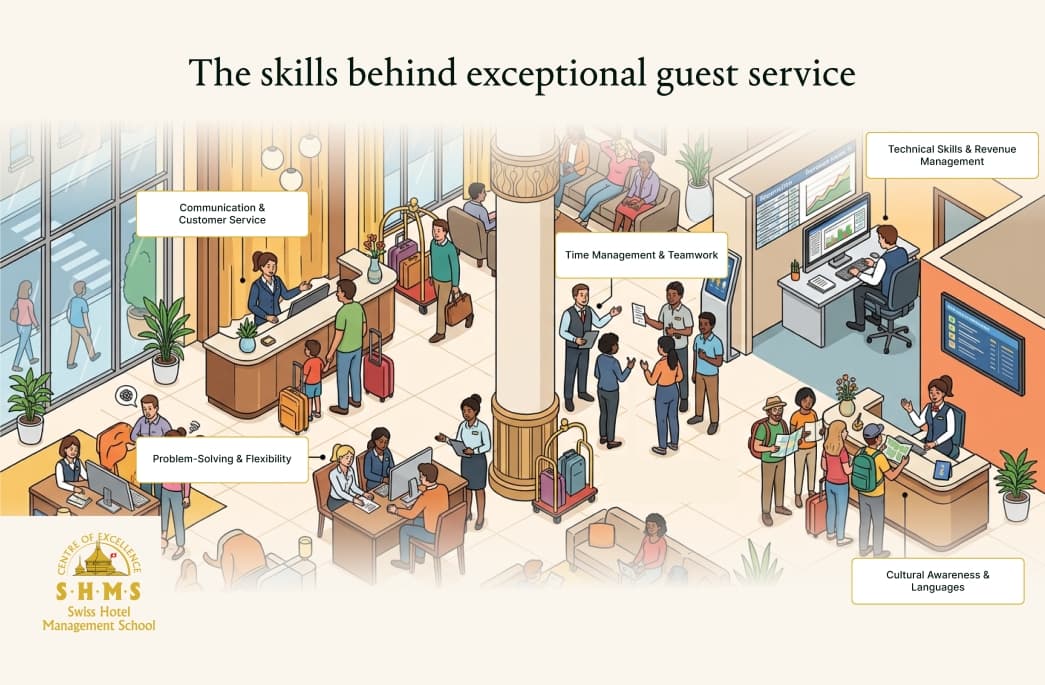
- Communication: guests, colleagues and suppliers all need clear information, often under time pressure.
- Customer service: the ability to read what a guest wants and deliver it, even when the request is unusual.
- Flexibility and adaptability: plans change with weather, delays and last-minute bookings, and managers adjust without losing standards.
- Time management: a check-in rush, an event setup and a staff briefing can all fall in the same hour.
- Cultural awareness: guests and teams come from many countries, and service expectations differ across cultures.
- Teamwork: a single guest stay passes through many departments, so colleagues need to work closely together.
- Problem-solving: an overbooked room or a missed transfer needs a quick, fair solution.
- Technical skills: booking and property management systems, point-of-sale systems and social media are part of daily work.
- Revenue management: pricing rooms, tours and event space by demand protects profit in busy and quiet periods.
- Languages: a second or third language opens jobs in international hotels, cruise lines and tour operators.
These hospitality skills are built faster with structured practice. At SHMS, students from more than 60 nationalities study together, and every student takes French or German alongside an English-language curriculum.
Why study tourism and hospitality in Switzerland
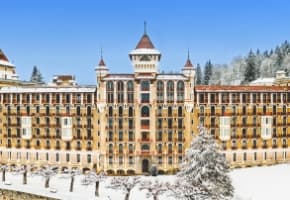
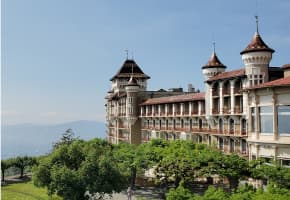
Switzerland has trained hoteliers since the 19th century, and its hotels still set the standard many luxury groups follow. Employers value Swiss-trained graduates because they arrive having worked to that standard in kitchens, restaurants and front offices. SHMS teaches inside two former palace hotels, Caux Palace above Lake Geneva and the Leysin campus in the Alps. In the 2026 QS World University Rankings, SHMS placed in the top 4 worldwide for Hospitality and Leisure Management.
Education and training opportunities in tourism and hospitality
Qualifications in the field come at several levels. Diplomas give a practical foundation in two to three years, bachelor's degrees add management and business depth, and master's degrees prepare graduates or career changers for senior and specialist roles. On-the-job training and short courses, such as wine or revenue management certifications, fill specific gaps along the way.
When choosing a program, look for:
- Practical training in real service settings
- Internships built into the program
- Specializations that match your goals
- International exposure through classmates, faculty and placements
SHMS programs offer one example of how these routes connect:
Program | Length | Internships | Award |
2–3 years | Two paid six-month internships | Swiss Advanced Federal Diploma of Higher Education | |
BA in International Hospitality Management | 3 years | Two paid six-month internships | Bachelor degrees from SHMS and the University of Derby, UK |
1–1.5 years | Optional internship | Master's degree accredited by the University of Derby |
Preparing for a Career in Tourism and Hospitality
Six steps help people move into the industry with a clear plan:
- Research the industry and its sectors: Compare accommodation, travel, events and recreation, and decide which suits your interests.
- Earn a relevant qualification: A diploma or degree in hospitality or tourism gives you business and operations knowledge before your first management role.
- Build core skills: Work on languages, customer service and basic finance, which every sector values.
- Gain experience through internships or part-time work: Some programs build paid internships into the degree. SHMS bachelor students complete two six-month placements worldwide.
- Attend industry events, job fairs and conferences: These are where recruiters meet candidates and where you learn how employers describe the roles they need.
- Follow industry trends: Reading trade news on technology, sustainability and travel demand prepares you for interview questions and shows employers you understand the business.
Finding jobs in tourism and hospitality
Most jobs are found through a mix of channels:
- Specialist hospitality job boards
- Company career pages, especially for large hotel groups and cruise lines
- Career fairs
- Recruitment agencies
- Personal networks
- School career services
- Alumni networks
- Former internship employers, who often hire interns back after graduation
SHMS students meet employers at the International Recruitment Forum (IRF). The forum runs twice a year with more than 100 recruiters from hotel groups, events companies, airlines and cruise lines.
Networking and building connections in the industry
Networking helps you hear about openings before they are advertised, meet the people who hire and learn how different employers work. Over time, it also builds a professional reputation that follows you between jobs.
Effective networking happens in several places:
- Industry events and trade shows
- Professional associations
- LinkedIn and other social media
- Alumni networks
- School career services
Start your tourism and hospitality career at SHMS
Hospitality and tourism together employ hundreds of millions of people, and the businesses behind each trip need managers who understand guests and the numbers equally well. The SHMS BA in International Hospitality Management prepares students for both. They spend academic semesters in former Swiss palace hotels and complete two paid six-month internships with employers worldwide, and they graduate with two bachelor degrees. The best way to judge whether the field fits is to see it in person: visit Caux and Leysin, sit in on a class and talk with current students.
Frequently Asked Questions
Should you study hospitality management or tourism management?
Hospitality management focuses on operations and guest service in hotels, restaurants, resorts and events. Tourism management focuses on destinations, travel flows and trip planning. Choose hospitality if you want to run a property or service business, and tourism if you are more interested in destination marketing, tour operations or travel planning. Many hospitality programs, including those at SHMS, also cover MICE and events, which sit across both fields.
Do you need a degree to work in tourism and hospitality?
Many entry roles need no degree. BLS notes that travel agents and lodging managers can enter with a high school diploma, though full-service hotels may prefer a degree in hospitality or hotel management. A degree speeds progression into management and gives access to international employers who recruit from hospitality schools. Whether that investment pays off depends on your goals, and our analysis of whether a hospitality degree is worth it sets out the trade-offs.
What is MICE tourism?
MICE stands for meetings, incentives, conferences and exhibitions. It covers business travel organized around events, such as a corporate retreat, a medical congress or a trade fair. The segment is valuable to hotels and destinations because groups book many rooms at once, often midweek and outside peak holiday periods, and spend on catering, meeting space and activities.
Which languages help most in tourism and hospitality?
English is the working language of international hospitality and travel. A second language adds most value when it matches your target market. Examples include French or German in Switzerland, Arabic in the Gulf and Mandarin for luxury travel serving Chinese visitors.
Can you work in tourism and hospitality without travelling?
Yes. Revenue management, marketing, sales and events roles are often office-based, and restaurant management keeps you in one location. Many people build entire careers in their home city, working for hotels, venues or travel companies there.
Are you wondering where to start your dream hospitality career? Look no further than a bachelor’s degree at Swiss Hotel Management School.