
- About
- Programs
- View all programs
- Professional Bachelor in Hospitality Management

- Bachelor of Arts in International Hospitality Management

- Master of Arts in International Hospitality Business Management
- Master of Arts in International Hospitality Business Management: Luxury Brand Management

- Master of Science in International Hospitality Management

- Master of Arts in Executive Hospitality Management (online)

- Master of Business Administration - MBA Global

- Postgraduate Diploma to Master of Advanced Studies in Business

- Postgraduate Diploma in International Hotel, Resort, and Spa Management

- Campus life
- Career Services
- Admissions
- News & Events
- Alumni













What Is Medical Tourism? How the Global Industry Works
Where hospitality meets healthcare? Discover what medical tourism is, how the industry works, top destinations, and the careers behind it.

Key Takeaways
- Medical tourism is travel abroad for medical care, usually to pay less or to be treated sooner.
- Hospitals provide medical treatment, but the rest of an international patient’s experience depends largely on hospitality services.
- Accredited hospitals and follow-up care arranged before departure lower the risks.
- Patient coordination, guest experience, medical spa management, and business development are usually managed by hospitality and business graduates.
Grand View Research forecasts that the global medical tourism market will reach about $126.2 billion by 2035, as more patients travel abroad for surgery, dental work, fertility treatment, and cancer care. The treatment happens in a hospital, but much of what surrounds it is travel and hospitality work, including arrival, accommodation, language support, and updates for the family.
Large hospitals now employ whole teams for that part of the stay. At Bumrungrad International Hospital in Bangkok, an airport team meets arriving patients, and more than 100 full-time translators help them speak with doctors in their own language. In Istanbul, the Acıbadem group gives each international patient a single multilingual coordinator who manages the case until follow-up care at home. This is hotel work carried into a clinical setting, and it has made medical tourism a career field for people trained in hospitality.
What Is Medical Tourism?
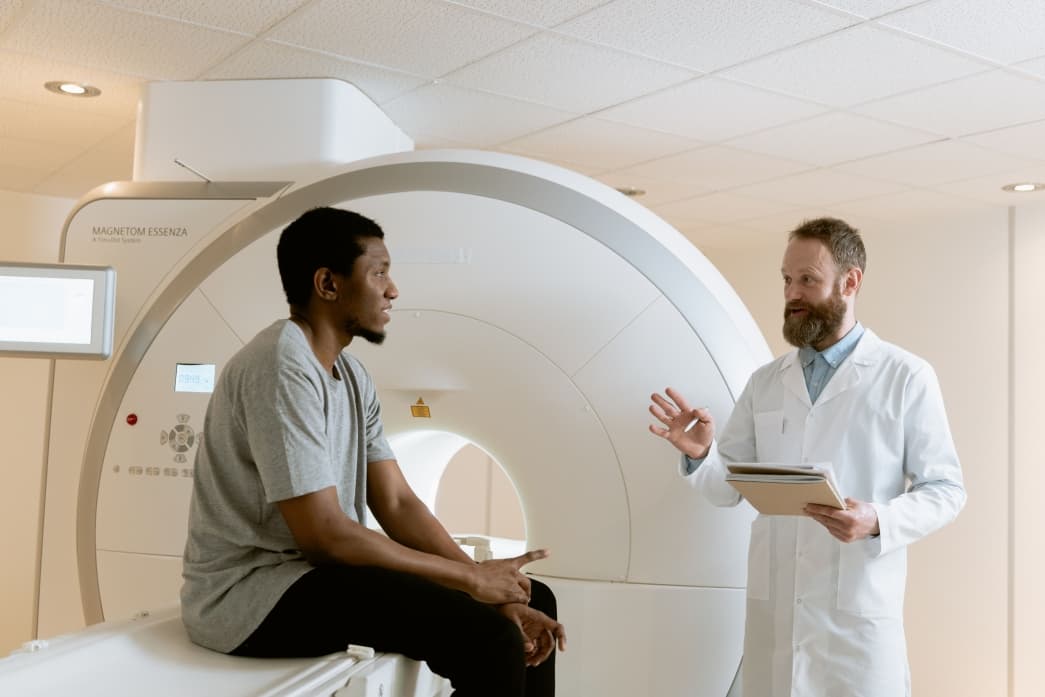
Medical tourism is the practice of traveling outside your country of residence to receive medical care. Patients most often travel for cancer treatment, cosmetic surgery, dental care, fertility treatment, or organ transplants. The US Centers for Disease Control and Prevention (CDC) identifies dental care as the most common form of medical tourism among US residents.
Patients travel in both directions. People in high-cost countries such as the United States go abroad for lower prices, and patients in countries with limited specialist capacity travel for treatment that is unavailable at home.
Medical tourism vs. wellness tourism
Medical tourism is clinical and focuses on diagnosis and treatment. Wellness tourism is travel for preventative care and wellbeing, and spa tourism is one of its oldest forms. Medical and wellness tourism overlap in medical spas, rehabilitation clinics, recovery resorts, and longevity centers. Guests at these places stay for days or weeks, and that is where hospitality training is needed.
Why Do People Travel Abroad for Medical Care?
Start Your Journey in the World of Hospitality
Turn your passion into a rewarding international career
The main reasons why patients travel abroad fall into six groups:
- Cost: Treatment abroad often costs a fraction of US and Western European prices. The CDC links the popularity of dental trips to rising US dental costs.
- Waiting lists: NHS England reported about 7.2 million cases waiting to start planned hospital treatment at the end of February 2026. Long waits lead some patients to pay to receive treatment faster abroad.
- Access: Some treatments are unavailable or scarce at home, so a specialist center abroad becomes the preferred option.
- Quality and accreditation: Internationally accredited hospitals let patients pay less while ensuring that providers meet recognized standards.
- Culture and language: Some patients prefer clinicians who share their language and culture, which makes consent conversations and aftercare instructions easier to understand.
- Treatment combined with travel: A recovery week can double as a trip, which ties medical tourism to cultural tourism and leisure travel.
How the Medical Tourism Industry Works
Medical tourism works as a network that links patients with accredited providers and with travel and hospitality services to support treatment. Grand View Research valued the market at $34.0 billion in 2025 and expects average annual growth of 14.1% through 2035.
The industry brings together five groups:
- Hospitals and clinics with international patient departments
- Medical travel facilitators, agencies that arrange quotes, flights, hotels, and appointments
- Accreditation bodies such as Joint Commission International (JCI), which has accredited more than 1,000 healthcare organizations
- Insurers and employers that pay for some treatment abroad
- Hotels, recovery residences, transport companies and translation services
A typical trip moves through six stages:
- Research and shortlisting of hospitals and doctors
- Remote consultation and a written quote
- Travel and hospital admission
- Treatment
- Recovery stay in the destination
- Follow-up care at home
According to the Medical Tourism Association, the price gap has two main causes. Wages and malpractice insurance cost less in destination countries, and US prices carry heavy insurance and administrative overhead. At JCI-accredited hospitals, independent inspectors check clinical processes against published international standards.
For an international patient, everything outside the operating room is a travel and hospitality service: the airport pickup, a bed for the relative who comes along, meals that suit the patient's diet and daily updates in a familiar language. Hospitals that serve many international patients build dedicated departments to deliver these services.
Top Medical Tourism Destinations
Which country leads depends on the measure, since each country counts medical visitors differently. Thailand, India, Turkey, Mexico, and Singapore are established destinations with large international patient programs, and Switzerland serves the premium end of the market.
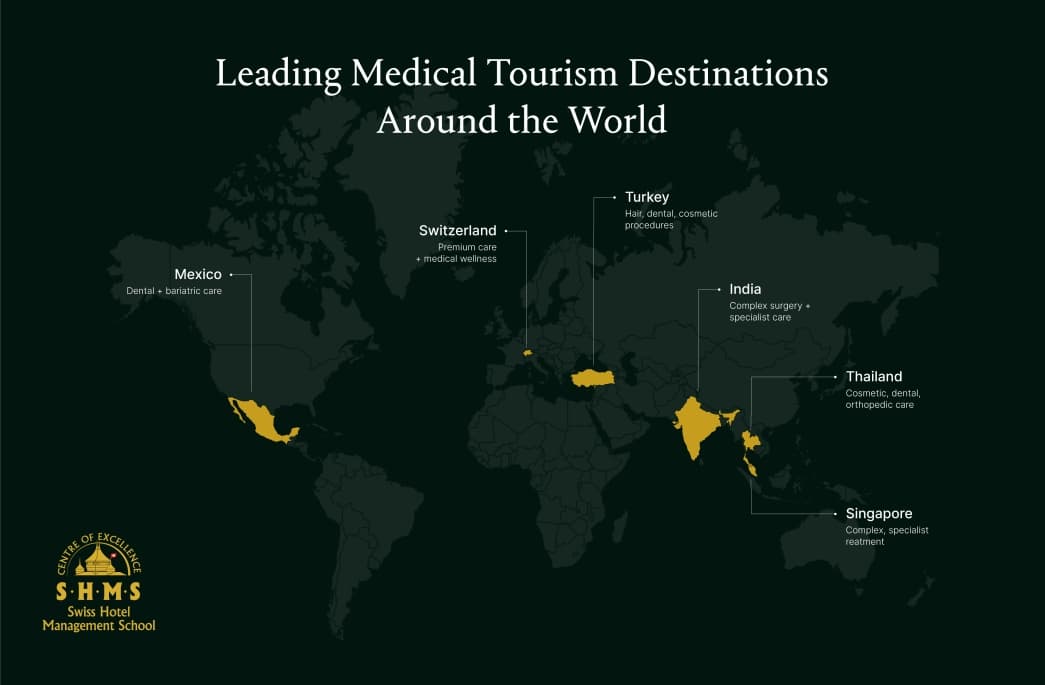
Across all six destinations, patients weigh the same five factors: international accreditation, price, direct flights, language support, and the standard of service around the treatment. The last factor is the one hospitality professionals shape most directly.
1. Thailand
Thailand is widely used for cosmetic surgery, dental care, health screenings, and orthopedic treatment. Bangkok's Bumrungrad International Hospital became the first hospital in Asia to earn JCI accreditation in 2002. It now cares for patients from more than 190 countries each year.
2. India
India is known for cardiac surgery, orthopedic procedures, organ transplants, and complex specialist operations at private groups such as Apollo Hospitals and Fortis Healthcare. India's Ministry of Tourism recorded about 644,000 foreign arrivals for medical purposes in 2024, around 75% of them from Bangladesh.
3. Turkey
Turkey is known for hair transplants, dental work, eye surgery, and cosmetic procedures, often sold as packages that include hotel stays and airport transfers. Istanbul hospital groups such as Acıbadem, which lists seven JCI-accredited hospitals, compete for international patients on accreditation as well as price.
4. Mexico
The CDC lists Mexico first among the places US medical tourists visit most often. Border cities such as Tijuana, a short drive from San Diego, draw many dental and bariatric patients. Resort areas such as Cancún combine clinics with holiday stays.
5. Singapore
Singapore attracts patients seeking complex and specialist care under strict regulation, delivered by English-speaking clinical teams. Private hospitals such as Mount Elizabeth run patient assistance centers for international visitors and report serving patients from more than 120 countries.
6. Switzerland
Switzerland serves the premium end of the market through private clinics, rehabilitation centers, longevity programs and medical wellness retreats, where patients pay for discretion and hotel-grade service. In Leysin, where the SHMS Mont Blanc Palace campus resides, physicians and hotel-keepers founded a climate-cure society in 1890. Dr. Auguste Rollier later ran 36 sun-therapy clinics with more than 1,000 beds there. On Lake Geneva, below the SHMS Caux Palace campus, Clinique La Prairie has operated since 1931.
Risks and Realities of Medical Tourism
Medical tourism can be safe when patients choose accredited providers and plan their aftercare. Standards still vary widely between facilities, and the CDC identifies infection as the most common complication among medical tourists.
Patients should plan for five main risks:
- Uneven quality between providers, including infection control
- Complications that appear after the flight home
- Gaps in follow-up care and missing medical records
- Blood clots and other problems from flying too soon after surgery
- Limited legal recourse when treatment abroad goes wrong
A 2026 systematic review by Holm and colleagues in the Journal of Plastic, Reconstructive & Aesthetic Surgery pooled 58 studies covering 1,249 patients treated at home for complications after cosmetic surgery abroad. Infection was the most frequently reported problem. The hospitals treating these patients often lacked the original surgeon's operative notes and implant details.
Before booking, patients can lower these risks in four ways:
- Verify accreditation in the accreditor's own online directory, such as JCI's list or a recognized national equivalent.
- Check the surgeon's credentials directly with their professional board.
- Arrange follow-up care at home before traveling and ask for full medical records in English.
- Plan recovery time in the destination, since the CDC advises waiting 10 days before flying after chest or abdominal surgery.
Where Hospitality Meets Healthcare: Careers in Medical Tourism

International patients judge a hospital on the whole stay, so the industry hires hospitality and business professionals alongside clinicians. That places medical tourism among the careers in hospitality you can prepare for with a hospitality or business education.
Luis Andre da Silva Pedro earned his SHMS degree in Hotel Operations Management. He has built his career where hospitality meets healthcare as head of hotel and customer services at The London Clinic, a private hospital in London. He describes his hiring directly: "I was recruited because the London Clinic wanted to deliver five-star hospitality within healthcare." He ran the department much as a general manager runs a luxury hotel, with its own front-of-house, concierge, housekeeping, and catering teams, and the clinic gave international patients in-house translators and their relatives meals and overnight beds.
As a hospitality- or business-trained professional, you could work as:
- A medical concierge, managing an international patient's non-clinical needs for the whole stay
- A guest or patient experience manager in a hospital's international patient department
- A medical spa or wellness resort manager, overseeing clinical programs in a hotel setting
- A medical travel facilitator or agency coordinator, handling bookings and paperwork before patients fly
- A business development manager for hospital guest services or wellness real estate with medical services
The SHMS Postgraduate Diploma to Master of Advanced Studies in Business covers the business side of this work through its Wellness & Longevity Business Management major. Its specialization modules focus on spa and medical wellness operations and on longevity and healthspan program design. In the live industry project, students design a longevity or regenerative wellness program for a luxury Swiss resort or an international clinic brand.
The program is stackable. You earn a Postgraduate Diploma after about six months and a Swiss Master of Advanced Studies in roughly a year, and the structure includes a supervised placement of six months to a year (exemption possible). The Leysin campus also runs a professional Beauty & Wellness spa, and SHMS students can take on the management of the school's spa facilities during their studies.
Turn Global Healthcare Into a Career Opportunity
Medical tourism has grown into a global industry in which the trip and the stay shape a patient's experience alongside the treatment. For students, that creates careers on the non-clinical side, where hospitality and business training prepare you to run coordination and guest experience around clinical care.
If that work appeals to you, explore the SHMS Postgraduate Diploma to Master of Advanced Studies in Business and its Wellness & Longevity Business Management major. Start with the role you would most like to hold, then look for the training and first jobs that lead to it.
Frequently Asked Questions
What accreditation should you look for when choosing a medical tourism hospital?
Look for JCI accreditation or accreditation from a national body recognized by the International Society for Quality in Health Care (ISQua), and confirm it in the accreditor's own directory. The CDC also advises researching the individual surgeon, since accreditation covers the hospital's systems.
Does health insurance cover medical tourism?
US patients usually pay out of pocket, although the CDC notes that some insurers and large employers have agreements with hospitals abroad. EU residents can have planned treatment in another EU country covered with prior authorization, or they can claim reimbursement up to what it would cost at home.
What is a medical travel facilitator, and how do you assess one?
A medical travel facilitator is an agency that matches patients with hospitals abroad and organizes the trip around their treatment. Ask which hospitals it works with, how they are accredited, how the agency is paid, and who covers care if complications arise.
What careers can students prepare for through a medical tourism-adjacent hospitality program?
Graduates can work as medical concierges, medical travel agency coordinators, patient experience managers, or medical spa managers. Business-focused programs add routes into hospital guest services and wellness real estate.
Take the leap — discover your future in hospitality with Swiss Hotel Management School.