


- About
- Programs
- View all programs
- Swiss Professional Degree (ES)


- Bachelor of Arts in International Hospitality Management

- Master of Arts in International Hospitality Business Management

- Master of Arts in International Hospitality Business Management: Luxury Brand Management

- Master of Science in International Hospitality Management

- Master of Arts in Executive Hospitality Management (online)

- Postgraduate Diploma in International Hotel, Resort, and Spa Management

- Campus life
- Career Services
- Admissions
- News & Events
- Alumni










The Fascinating History of Palace Hotels Around the World
Explore the complete history of palace hotels. From their Gilded Age origins to their roles as cultural hubs, learn the full story of these grand properties.


Key Takeaways
- Palace hotels originated during the Gilded Age in the 19th century as symbols of wealth and social status.
- Many began as actual royal palaces before being converted into luxury hotels, while others were purpose-built as grand accommodations.
- These properties served as cultural and social gathering places for political leaders, artists, and international elites.
- Modern palace hotels balance heritage preservation with contemporary luxury expectations and sustainability practices.
Most of what surrounds us today reflects modern taste—minimalist glass façades, bold geometric shapes, and futuristic designs that define the skylines of cities around the world. Yet, every so often, a glimpse of the past appears in the form of grand buildings that seem untouched by time. Among the most striking of these are palace hotels.
The history of palace hotels reflects a time when travel was reserved for society's elite, and hotels became stages upon which luxury was displayed at its most lavish. From ornate ballrooms to gilded dining halls, these properties were designed not just to host guests but to awe them, each one striving to surpass the other in grandeur and refinement.
What Defines a True Palace Hotel?
A true palace hotel is one that transcends typical luxury accommodation through a unique combination of architectural magnificence, historical significance, and cultural importance. These properties demonstrate exceptional design elements, often featuring ornate façades, grand ballrooms, and intricate interior details that reflect royal or aristocratic heritage.


Historical importance distinguishes palace hotels from other luxury properties. Many began as actual palaces, royal residences, or aristocratic mansions before being converted into hotels. Others were purpose-built during the golden age of grand hotel construction, designed specifically to rival royal accommodations in opulence and service standards.
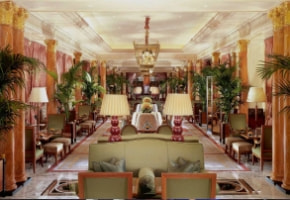
Architectural elements typically include soaring ceilings, marble columns, crystal chandeliers, and elaborate decorative details that showcase the craftsmanship and artistic sensibilities of their era. These features create an atmosphere of grandeur that cannot be replicated in modern construction.
Official recognition systems also help define which hotels are distinguished palaces. In France, the prestigious "Palace" classification, established in 2010, designates the highest level of distinction. It is awarded only to hotels that combine exceptional luxury with a rich heritage and cultural significance. Other countries have introduced similar systems, giving official recognition to properties that deliver palace-level hospitality at the highest standards.
The Birth of Grandeur, The Gilded Age, and Belle Époque
The emergence of palace hotels coincided with the late 19th century's Gilded Age in the United States and the Belle Époque in Europe. Rapid industrial growth during these eras gave rise to a new class of wealthy industrialists and entrepreneurs who sought accommodations that reflected their elevated status and refined tastes.
Technological advances during this time transformed travel accessibility and comfort. The expansion of railway networks across Europe and America made luxury travel feasible for the wealthy elite, while improvements in steamship design enabled comfortable trans-Atlantic journeys. These transportation developments created demand for exceptional accommodations at major destinations.
The social climate also emphasized conspicuous consumption and cultural sophistication. Wealthy families competed to demonstrate their status through grand homes, elaborate entertaining, and luxurious travel experiences. Palace hotels provided venues where this social competition could unfold in public settings.
It was the economic prosperity of the era that made such lavish palace hotels possible. As industrial expansion created new wealth, both travelers and developers benefited: industrialists and entrepreneurs became the wealthy clientele, while developers now had the capital to invest in grand hotels designed to meet their tastes.
A Tour of Legendary Palace Hotels Worldwide
The world's most celebrated palace hotels established luxury accommodation in such a way that continues to influence modern hospitality design and service standards. Each property demonstrates distinctive characteristics that reflect its geographical location, historical context, and cultural influences.
Caux Palace Hotel - Caux, Switzerland


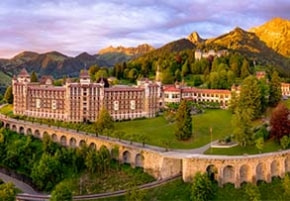
Built in 1902, the Caux Palace was once one of the most luxurious hotels in Switzerland, attracting Europe's elite during the Belle Époque. Its striking architecture incorporates grand halls, sweeping staircases, and panoramic terraces overlooking Lake Geneva.
Before the outbreak of the Second World War, it welcomed distinguished guests such as the then-future king of Saudi Arabia, Prince Ibn Saud, English author Rudyard Kipling, American magnate John D. Rockefeller, and the Kellogg and Gillette families. During the war, the palace sheltered Jewish-Hungarian refugees, adding to its cultural importance.
Today, it serves as the home of Swiss Hotel Management School (SHMS), where students live and study within this historic setting. SHMS student Eugenia González describes her first impression of the Caux campus as "absolutely beautiful and with an incredible view—a magical place to study." For her, studying hospitality in such a palace adds authenticity to her training:
Living in one of the true and original Swiss hospitality settings really enhances the experience and motivation of becoming a hotelier.
Her reflections capture what many students feel as SHMS students at Caux—everyday life becomes part of history, and the setting itself deepens their preparation for future leadership in hospitality.
Most recently, the Caux Palace became the star of the Netflix and RTS period drama "Winter Palace". The series follows the ambitions and challenges of building a luxury hotel in the Alps at the dawn of the 20th century. Inspired by hospitality pioneers such as César Ritz, the story captures the spirit of innovation and vision that shaped the Belle Époque.
The Belvédère and Mont Blanc Palace - Leysin, Switzerland
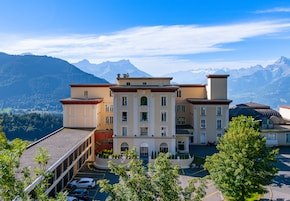
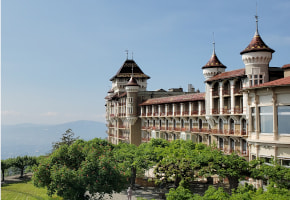
The Mont Blanc Palace and the Belvédère Hotel were originally built to serve Europe's winter elite, offering stunning alpine views and a luxurious mountain retreat. These grand properties reflected the growth of leisure tourism during the Belle Époque, when Switzerland became synonymous with health resorts and mountain air. Their design blends Belle Époque elegance with chalet-style touches suited to their alpine surroundings. Notably, the Mont Blanc Palace would go on to become the first winter Club Med in the world, marking an important moment in the evolution of alpine tourism.
Start Your Journey in the World of Hospitality
Turn your passion into a rewarding international career


Today, they too welcome SHMS students, as together they form the school's Leysin campus. Students live and study in these historic hotels, carrying forward their legacy of hospitality. The vast windows overlooking the mountains, the sense of grandeur in the halls, and the balance between tradition and modern student life create a unique training ground.
For SHMS students, the experience of walking through the same corridors once graced by aristocratic winter guests connects their daily education to hospitality history in a tangible way.
The Lotte New York Palace - Manhattan, USA
The Lotte New York Palace combines the late-19th-century Villard Houses, designed in 1882 by architect Stanford White, with a modern skyscraper tower added in the 1970s. Originally built as mansions for the wealthy Villard family, the complex was later converted into one of Manhattan's most iconic palace hotels. Its courtyard, grand staircase, and Renaissance-inspired interiors carry echoes of Gilded Age opulence, even as the adjoining tower symbolizes modern New York ambition.
The hotel has hosted world leaders, celebrities, and dignitaries, becoming both a cultural landmark and a television icon through frequent appearances on shows like "Gossip Girl". Today, it stands as a blend of historic heritage and contemporary luxury in the heart of Midtown.
Le Palace de Megève - Megève, France
Opened in the 1920s, Le Palace de Megève was developed as part of Baroness Noémie de Rothschild's vision to create a glamorous French ski resort to rival Switzerland's St. Moritz. Its architecture combines alpine charm with refined luxury, embodying the Belle Époque's influence even in a mountain setting.
Through the decades, the hotel attracted Parisian high society and European aristocracy, cementing Megève's reputation as a chic winter destination. Today, the property remains a cultural touchstone in French hospitality, representing the fusion of sport, luxury, and tradition.
Palace Hotel - San Francisco, USA
Originally built in 1875, the Palace Hotel was the first premier luxury hotel on the American West Coast, conceived during San Francisco's boom years as a bold statement of prosperity and ambition. Destroyed in the 1906 earthquake and fire, it rose again in 1909 with a grand Beaux-Arts design that redefined the city's skyline and spirit of resilience.
Its most iconic feature, the Garden Court, with its soaring glass dome and Austrian crystal chandeliers, continues to symbolize grandeur and elegance. Over the decades, the hotel has welcomed presidents, royalty, and cultural icons, from U.S. leaders to legendary performers, embedding itself in the social and political life of San Francisco.
Taj Lake Palace - Udaipur, India
Built in 1746 by Maharana Jagat Singh II, the Taj Lake Palace was originally conceived as a royal summer retreat on the serene waters of Lake Pichola. Constructed from gleaming white marble, the palace appears to float magically on the water, accessible only by boat, and is one of the most photographed palace hotels in the world.


Over the centuries, it has hosted royalty, film stars, and dignitaries, earning international fame after featuring in a "James Bond" film. The palace is renowned for its exquisite courtyards, intricate inlay work, and lavish interiors that reflect the grandeur of Rajasthan's royal traditions.
Today, the Taj Lake Palace continues to embody India's regal hospitality, offering guests a living experience of history, architecture, and natural beauty intertwined.
The Gritti Palace - Venice, Italy
Dating back to 1525, the Gritti Palace was originally built as the private residence of Andrea Gritti, Doge of Venice. It was transformed into a luxury hotel in 1895, merging Renaissance architecture with Venetian craftsmanship and decorative arts.
Through the years, the hotel has hosted literary and cultural elites, from Ernest Hemingway to Peggy Guggenheim, all drawn by Venice's mystique and the Gritti's elegance. Its reputation as a hub of refined culture continues today, blending historic grandeur with modern hospitality. The Gritti Palace remains a jewel of Venetian tradition, where art, history, and luxury intersect.
Çırağan Palace Kempinski - Istanbul, Turkey
Once the imperial palace of Sultan Abdülaziz, built in the 1860s, the Çırağan Palace occupies a prime position along the Bosphorus. The interiors, with their gilded ceilings, hand-carved woodwork, and vast ceremonial halls, reflect the lavish grandeur of the Ottoman court.


Falling into disrepair during the early 20th century, the palace was restored and converted into a luxury hotel in the 1990s, blending imperial splendor with contemporary service.
Today, it is a stage for international diplomacy and culture, hosting royal families, political summits, and high-profile events. The Çırağan Palace Kempinski remains one of Istanbul's most iconic landmarks, symbolizing the city's unique blend of East and West.
Palace Hotels as Cultural and Social Landmarks
From their earliest days, palace hotels were important for more than just hospitality. They embodied a new idea: that a hotel could be a showcase of national pride, innovation, and cultural ambition.
Electricity, elevators, telephones, and even central heating often appeared in palace hotels before they became commonplace in private homes. To stay in such a place, in a way, meant to experience the future.

At the same time, these hotels offered a stage on which society could see itself reflected. Grand ballrooms and dining halls functioned as arenas of prestige, where social hierarchies were reinforced yet also subtly challenged. Writers, artists, aristocrats, and business magnates shared the same corridors, creating a rare space where cultural currents intertwined. In this sense, palace hotels helped set the tone for modern cosmopolitan life, where luxury was tied to the exchange of ideas as much as it was to wealth.
Their legacy as cultural and social landmarks endures because they distilled the values of their time into a physical space: ambition, elegance, innovation, and the performance of status. Their enduring appeal comes from both their beauty and the way they capture the values and aspirations of the time.
Keeping the Golden Age Alive

Palace hotels demand constant care to remain what they were always meant to be: symbols of elegance and excellence. Because of this challenge, some properties have taken on new roles as museums or cultural centers; however, there are also many that continue to operate as hotels by striking a careful balance between heritage and modernity. Their success depends on honoring the craftsmanship and atmosphere of their past while integrating the comforts today's travelers expect.
Restoration projects, discreet updates, and sustainability initiatives all play a part in this effort. The reward is an experience where history feels alive and guests can admire Belle Époque ballrooms or marble staircases while still enjoying the ease of contemporary service. This blend of preservation and innovation is what allows palace hotels to appeal across generations while still keeping the Golden Age alive.
The Living Legacy of Palace Hotels
Palace hotels still serve as inspiration for modern hospitality. The campuses of SHMS are a living example of this evolution. The Caux Palace and the historic hotels of Leysin were once playgrounds for Europe's elite; today, they are places of learning where modern technology and academic innovation share space with Belle Époque ballrooms and alpine grandeur. These grand hotels may no longer function as they were intended, but their role is no less important: the continue to inspire hospitality today
Within this setting, programs such as the BA in International Hospitality Management and the MA in International Hospitality Business Management prepare students to respect tradition while driving the industry forward. By learning in palace hotels themselves, students gain a unique appreciation for heritage while developing the skills to meet the expectations of future guests.
So, join one of our programs at SHMS and you will get to experience hospitality where it began—studying and working within the walls of authentic palace hotels.
Frequently Asked Questions
What is the difference between a 5-star hotel and a palace hotel?
Palace hotels go beyond 5-star status by combining historic significance, architectural grandeur, and cultural value with luxury amenities, qualities so distinctive they often require official recognition.
What is the most famous palace hotel?
Several properties claim this distinction, including The Plaza in New York, The Ritz in Paris, and Claridge's in London, each representing pinnacles of luxury hospitality in their respective regions.
Can you stay in the Caux Palace?
Caux Palace no longer operates as a traditional hotel. For most of the year it serves as a campus for SHMS, where its architecture and heritage are preserved by the rent and continue to inspire hospitality through education. In Spring and summer Caux Palace is available for events of up to 350 people, including lodging. See the Caux Foundation website for more information.
Are you wondering where to start your dream hospitality career? Look no further than a bachelor’s degree at Swiss Hotel Management School.